
What are veneers?
Veneers are thin shells that are specially produced and glued to the front surface of the teeth to improve the function of the teeth or the looks of the smile. They are usually composed of porcelain or composite materials to match the natural color of the teeth.
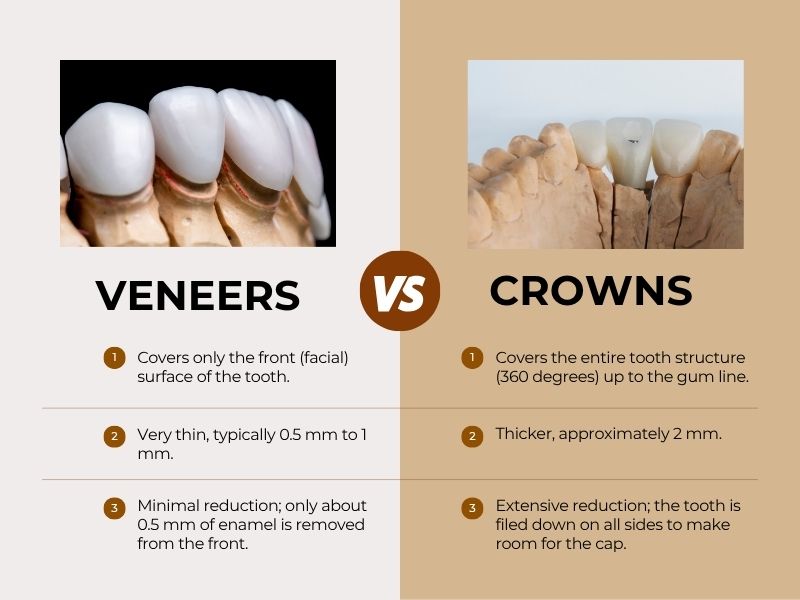
“Veneers are typically ideal for patients who don't have serious tooth decay or major damage to their teeth but want to improve the look of their smile. If a considerable piece of the tooth has been lost or structural support is needed, crown (full covering) treatment is usually indicated.
The main characteristics and uses of veneers are as follows:
- Applications: Used to fix spaces between teeth (diastema), correct misalignment, mend cracks or fractures, and cover permanent stains or discoloration.
- Structure and thickness: Veneers are about 1 mm thick (sometimes as thin as 0.3–0.5 mm). Unlike crowns, they are restricted to the visible front surface of the tooth and not the entire tooth.
- Application process: It is a less intrusive method than crown (cap) treatment. During the preparation phase, only a very tiny piece of enamel is removed, usually about 0.5 mm; thus, the natural structure of the tooth is kept to a considerable extent.
- Requirements: There must be enough healthy enamel on the tooth for the veneer to attach correctly.
- Aesthetic benefits: They can enhance the appearance of the patient dramatically by altering the form, size, and color of the teeth. In addition, porcelain veneers are stain resistant and a long-term cosmetic solution.
What are dental crowns?
Dental crowns are described as a 'cap' or 'cover,' which is placed over a tooth that is broken, weakened, or aesthetically imperfect and which covers the whole visible surface of the tooth above the gum line. A crown is different from a veneer (laminate) because it covers the whole tooth, 360 degrees around, which helps to support the tooth and protect it.
Crowns are a more invasive operation than veneers (greater tooth reduction is needed), but they are far better at maintaining the structural integrity of the tooth and providing resistance to biting pressures.
Uses:
When a filling isn't enough to salvage the tooth, dental crowns are usually the way to go. Their principal uses are as follows:
- Protection of weak teeth: They are used to provide support and protection to weakened teeth that have been weakened owing to disease, excessive wear, or particularly big fillings, keeping them from shattering.
- Teeth repair: Restores the shape and function of broken, cracked, or severely worn teeth.
- Support after root canal treatment: Roots that have had root canals are often more fragile, and a crown is needed to preserve them.
- Cosmetic enhancement: It is used to cover up teeth with severe discoloration or irregular form.
- Supporting dental bridges: Crowns can be applied to surrounding teeth to support a dental bridge.
Materials used
Crowns can be manufactured from several materials based on the tooth position in the mouth and the patient's aesthetic expectations:
- Metal: Usually made with alloys such as gold, palladium, nickel, or chromium. They are incredibly durable and require little tooth reduction, but they do not match the natural color of the teeth.
- Porcelain-fused-to-metal (PFM): Metal core with a natural-colored porcelain exterior. It has good durability and beauty, although you may see a small dark line of metal at the gum line.
- All-ceramic or porcelain:The most natural-looking alternative and best used for front teeth.
- Zirconia:This is a very hard and durable material that is really beautiful since it is made by coating a core of zirconia oxide with a porcelain veneer.
Partial crowns
In some circumstances, the 'partial veneer crowns' (e.g., 3/4 or 7/8 crowns) may be utilized, which do not cover the whole tooth but only a portion of the tooth. This procedure is preferred in order to keep the healthy tooth tissue as much as feasible.
When to choose veneers vs crowns
The choice of whether to go for a veneer (laminate) or a crown is mostly based on the current condition of the tooth and if the treatment is aimed at improving the aesthetics or protecting the structure. Here are the essential characteristics to help you select between these two options:
When should a veneer (laminate) be chosen?
In the following cases a veneer is the ideal choice:
- Sound tooth structure: A veneer is preferable if a major part of the tooth is sound and there is sufficient healthy enamel.
- Cosmetic defects: Great at repairing persistent stains, tiny cracks, wear, or filling gaps between teeth (diastema).
- Minor shape irregularities: These are utilized when a modest modification of the size or the position of the teeth is desired (often called 'instant orthodontics').
- Minimal tooth reduction: Veneers need the removal of a very little quantity of tooth enamel, usually between 0.3 and 1 mm, and this is a priority when protecting the tooth structure.
When should a crown be chosen?
A crown is warranted under the following circumstances:
- Significantly damaged teeth: When a tooth is compromised by a major cavity, fracture, or crack, a crown can support the tooth and prevent additional harm.
- Massive Fillings: If there are old massive fillings covering much of the teeth, a crown will be needed to provide structural support.
- After Root Canal Therapy: Teeth that have had root canal therapy tend to be more fragile, and crowns are recommended to safeguard them.
- Heavy wear and erosion: When a large part of the tooth is missing on the front and back, a veneer will not give enough support. A crown protects the tooth by functioning as a 'brace.'
- High chewing forces: Crowns are a more durable option, particularly for rear teeth or if the patient grinds their teeth (bruxism).
Dental Veneers vs. Dental Crowns
|
Feature |
Dental Veneers (Lamina) |
Dental Crowns (Full Coverage) |
|
Coverage |
Covers only the front (facial) surface of the tooth. |
Covers the entire tooth structure (360 degrees) up to the gum line. |
|
Thickness |
Very thin, typically 0.5 mm to 1 mm. |
Thicker, approximately 2 mm. |
|
Tooth Preparation |
Minimal reduction; only about 0.5 mm of enamel is removed from the front. |
Extensive reduction; the tooth is filed down on all sides to make room for the cap. |
|
Materials |
Primarily porcelain or composite resin. |
All-metal (gold, nickel), PFM (porcelain-fused-to-metal), all-ceramic, or zirconia. |
|
Primary Purpose |
Mainly cosmetic enhancement: gaps, minor chips, stains, and mild malalignment. |
Structural restoration: protecting weakened, cracked, broken, or root canal-treated teeth. |
|
Bracing Effect |
Does not provide significant structural support or protection for the back of the tooth. |
Provides a "bracing" effect to maintain structural integrity under chewing forces. |
|
Lifespan |
Can last 10–20 years with excellent care (93.5% survival rate over 10 years reported). |
Average lifespan is 5–10 years, but can last 20–30 years with meticulous hygiene. |
|
Reversibility |
Irreversible; once enamel is removed, the tooth will always need a restoration. |
Irreversible; requires permanent coverage for the life of the tooth. |
|
Cost (Estimated) |
$925 – $2,500 per tooth (often not covered by insurance as it is elective/cosmetic). |
$1,000 – $3,500 per tooth (insurance may cover a portion if medically necessary). |
|
Main Advantage |
Preserves more natural tooth structure and provides high esthetics. |
Strongest protection against fractures and decay for heavily damaged teeth. |
|
Main Risk |
Fragile; can chip or debond if under heavy force or if the patient grinds teeth. |
More invasive; may lead to increased sensitivity or require root canal therapy in rare cases. |
F.A.Q:
What is the difference between a veneer and a crown?
A veneer is a thin shell glued solely to the front surface of the tooth, while a crown is like a 'cap' that covers the whole tooth.
When is veneer the treatment of choice?
For little chips, gaps, discoloration, or slight misalignments, a veneer is sufficient.
When to get a crown?
Crowns are used to cover teeth that have extensive fillings, have had root canals, are cracked, or have substantial damage to their structure.
Is there a difference in treatment time?
Veneers are usually done in two sessions. Crowns usually also require two appointments but may take longer if a root canal is needed.
Crowns or veneers, which last longer?
Crowns are stronger. They can survive the chewing forces at the back of the mouth for 10–15 years. Veneers usually last between 5 and 10 years.
Which one appears more natural?
Both look natural when they are done effectively. But veneers are considered more cosmetic because of their translucency, especially on front teeth.
Does it alter both colors?
Porcelain veneers and crowns are stain-resistant. Composite veneers are more likely to undergo color change with time.
How to repair worn-out veneers and crowns
You can remove the veneer and bond on a new one. If a crown is removed, the tooth beneath is prepped again and may need a root canal treatment.
Who is better suited to someone who grinds or clenches their teeth?
If the patient is a bruxer, a crown is safer. Veneers can break. You must wear a night guard.
Do they both need anesthesia?
Veneers usually don't require anesthesia (minimum preparation). Crowns are generally always done using local anesthesia.
Can I have my veneers and crowns at the same time?
Yes. To get an aesthetic outcome, you can put a crown on the front incisor and veneers on the adjacent teeth.
What sensitivity is there after veneers or crowns?
There may be temporary sensitivity. The more tooth structure that is eliminated, the more risk for sensitivity with crowns.