
What is teeth straightening?
Orthodontic treatment, also known as teeth straightening, is a process used to improve the appearance, position, and function of crooked or misaligned teeth. This procedure involves gently moving the teeth into ideal alignment with the adjacent teeth, and sometimes rotating them
Why straighten teeth?
Straightening teeth is not merely an aesthetic choice; it is also an important investment in both oral health and general well-being. The process of straightening teeth extends the lifespan of your teeth, enhances daily comfort, and protects you from more costly or painful treatments in the future. Reasons for straightening teeth and the benefits they provide:
Aesthetic appearance and self-confidence
The most common reason why many people seek this treatment is the desire to have a more attractive smile. Crooked or gapped teeth can undermine a person’s self-confidence, causing them to feel the need to hide their mouth when smiling or speaking. The straight alignment of the teeth achieved after treatment enables the person to feel much more confident and happy in their social life.
Easier cleaning and oral health
Brushing and flossing properly aligned teeth is much easier. When teeth are crooked or very close together, food particles and bacteria can easily become trapped between them; this increases the risk of tooth decay and gum disease (periodontal disease). When teeth are properly aligned, the gums fit more snugly around them, which helps maintain gum health and reduces problems such as bleeding or mouth sores.
Functional improvement and digestion
Orthodontic treatment ensures that the upper and lower teeth fit together fully and effectively (a correct bite). A correct bite improves the digestive process by allowing food to be chewed more effectively. It also helps to correct speech impediments caused by misaligned teeth.
Pain relief and physical protection
Misaligned teeth place an uneven load on the jaw joints and supporting bone tissue. Orthodontic treatment can help resolve the following issues:
- Temporomandibular joint (TMJ) problems, teeth grinding, and clenching.
- Head and neck pain caused by misaligned teeth.
- Reduced risk of premature tooth wear or damage from impacts.
General health
Poor oral hygiene can lead to serious infections. Good oral health, achieved through orthodontic treatment, forms part of a holistic approach to health aimed at preventing serious systemic conditions such as heart disease, stroke, and diabetes.
What are the methods of orthodontic treatment?
There are many different methods used for orthodontic treatment. These methods vary depending on the degree of misalignment of the teeth, the patient’s aesthetic expectations, and their lifestyle:
Traditional brackets and wires (Fixed treatment)
This is the most common and well-known method. Brackets are bonded to the teeth, and wires are threaded through them to guide the teeth into their ideal position.
H-4: Metal brackets:
This is the most traditional and economical option; it can treat a wide variety of dental problems.
H-4: Ceramic brackets:
They are the same size as metal brackets but are much less noticeable as they are tooth-colored or transparent.
Clear aligners (Invisalign, etc.)
This is a popular alternative for those who do not wish to use braces. It consists of a series of custom-made, clear, and removable plastic trays that are fitted over the teeth.
- Advantages: They are virtually invisible, can be removed whilst eating or brushing your teeth, and are generally more comfortable than traditional braces.
- Usage: The aligners should be worn for approximately 20–22 hours a day and replaced with a new set every two weeks.
Invisible (Lingual) Braces
In this method, the brackets and wires are attached to the back surface of the teeth, on the tongue side, rather than the front surface. As a result, it is completely invisible from the outside, making it a fully aesthetic solution.
Methods that deliver quick results
H-4: Six Month Smiles:
This is a system that focuses solely on the front teeth, which are visible when smiling. It aims to complete treatment in approximately six months using clear brackets and tooth-colored wires.
H-4: Inman Aligner:
A removable appliance used specifically for crowding, protrusion, or gaps in the front teeth. By gently pushing the teeth using a spring-loaded system, it typically delivers results in a very short time, usually between 6 and 16 weeks.
Cosmetic and alternative solutions
H-4: Veneers and Lumineers:
Rather than altering the position of the teeth, a layer of porcelain is applied to the surface to conceal gaps or irregularities in shape.
H-4: Snap-on smile:
A removable ‘perfect smile’ appliance that fits over your existing teeth; it is a less invasive option.
Which method is right for you?
Which method is right for you depends on the complexity of your dental issue and the results of a clinical examination. For example, while traditional braces may provide faster and more effective results for severe misalignments, clear aligners may be preferred for milder cases.
How to straighten teeth without braces: 8 Expert-approved options
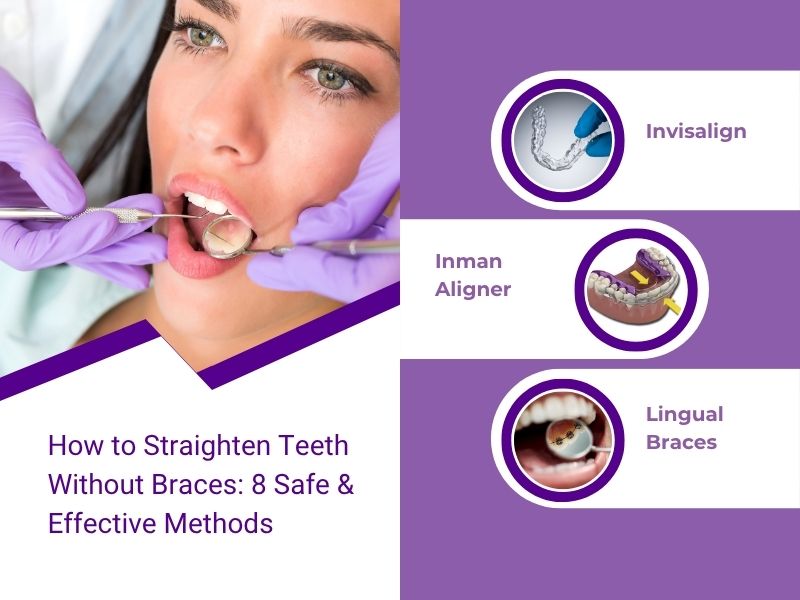
Advances in modern dentistry offer many aesthetic and comfortable options for straightening teeth without the use of traditional metal braces. The 8 different teeth-straightening options approved by experts are as follows:
1. Invisalign
This is one of the most popular alternatives. It consists of custom-made, clear, removable plastic aligners that fit over the teeth like contact lenses.
- How does it work? Each aligner is worn for approximately two weeks to gradually move the teeth into their ideal position, after which the patient moves on to the next aligner in the series.
- Advantages: They are virtually invisible, can be removed while eating, and are very easy to clean.
2. Inman aligner
A revolutionary device designed specifically to address issues such as crowding, gaps, or protrusion in the front teeth.
- How does it work? Two transparent springs, placed behind the teeth and activated by springs, gently guide the teeth into the correct position.
- Treatment duration: Very fast; results are typically achieved within 6 to 16 weeks.
3. Invisible (Lingual) braces
- Unlike traditional braces, these braces are attached not to the front surface of the teeth but to the back surface on the tongue side.
- As the small brackets and archwires are bonded to the back of the teeth, they are completely invisible when viewed from the outside.
4. Porcelain veneers and laminates (Lumineers)
- Rather than physically moving the teeth, these are thin porcelain shells applied to the surface of the teeth.
- They instantly ‘mask’ gaps, irregularities, or slight misalignments in the teeth, creating a perfect smile.
5. Snap-on smile
- This is a non-invasive, removable appliance that fits over your existing teeth.
- It is custom-made by a dentist to fit your teeth perfectly; it offers an immediate aesthetic improvement without the need for injections or drilling.
6. Dental bonding
- This is the application of tooth-colored composite resin to fill small gaps in the teeth or correct irregularities in their shape.
- It is generally a quick and cost-effective solution for correcting minor misalignments or gaps.
7. At-home aligners
- This method allows the majority of the process to be managed at home following an initial professional consultation.
- Transparent aligners, made following an initial examination and digital scan, are worn by the patient at home according to a schedule, under the supervision of a dentist
8. Retainers
Although retainers are generally used to maintain the results of treatment, they can also be used to correct slight tooth movement or minor relapses following previous treatment.
Who can straighten their teeth without braces?
There are now many options available for those wishing to straighten their teeth without braces, but the suitability of these methods depends on the individual’s dental structure and needs. People and situations where treatment without braces is possible include:
People who have mild to moderate misalignment
Adults with mild to moderate misalignment should use clear aligners like Invisalign. This treatment employs plastic trays that are developed particularly for you to slowly move your teeth into the right place.
People who have had orthodontic treatment before (Relapse)
Adults who got braces as kids but didn't use a retainer and their teeth slowly moved back to their original position (moderate relapse) are good candidates for clear aligner treatment.
People who solely have problems with their front teeth
If the only problem with the six front teeth that show when you smile is crowding, protrusion, or gaps, the following people may choose to get braces-free:
- Inman aligner users: This is a good choice for people whose permanent teeth have fully erupted and who want results quickly (6–16 weeks).
- Six month smiles: A choice for those who want to swiftly fix cosmetic problems with their front teeth.
Professionals who care about looks and social issues
People who think braces might hurt their career or social life, people who want the treatment to go unnoticed, and teens who want to keep their confidence may choose transparent aligners or lingual braces.
People who need to keep their mouths very clean
People who have lost bone because of gum disease in the past or who want to make brushing and flossing their teeth easier may choose removable aligners instead of set braces.
People who want quick results (cosmetic solutions)
If you don't want to move your teeth but want to hide gaps or misalignments, veneers (laminates) or Snap-on Smiles are good options. These procedures don't fix the teeth; they just "mask" them to make them look tidy.
Who are they not suitable for?
Traditional braces work better in the following situations:
- Severe crowding: When teeth need to be pulled out to make them line up.
- Very bad jaw alignment: People with a very bad overbite or underbite.
- People who have trouble with discipline: Treatment may not work for people who can't stick to wearing transparent aligners for at least 22 hours a day because they can be taken off.
F.A.Q:
Do teeth straightening methods without braces cause pain?
When you get a new pair of clear aligners, you could feel a little bit of pressure for one to two days. There is no discomfort with bonding or veneer treatments. The only thing that could hurt is the tooth surface being roughened.
Are the devices commonly referred to as ‘teeth straighteners’ for home use safe?
No. Online stores sell single-piece silicone molds and "natural" straighteners that can hurt tooth roots, cause gum recession, and create malocclusion.
How long does clear aligner treatment take?
It usually takes between 6 and 18 months. How long the treatment lasts depends on how bad the misalignment is and how long the person has to wear the aligners each day (20–22 hours).
How does tooth straightening with porcelain veneers work?
Attaching thin porcelain to the front of the teeth makes them look better right away. This is not an orthodontic procedure, though; it is a cosmetic veneer. Braces should be the first thing you try if your teeth are very crooked.
Can teeth be straightened using bonding (composite fillings)?
If the teeth are somewhat misaligned, damaged, or spaced, bonding means putting a filling substance to the tooth to make it look even. But it doesn't fix the misalignment; it just hides it from view.
Does a retainer (retainer appliance) straighten teeth?
No. A retainer is needed after braces to keep the teeth from going back to their original position. It doesn't fix misalignment by itself.
Are lingual (back surface) braces considered a brace-free option?
In terms of medicine, these are "braces," but you can't see them from the outside. They are great for people who don't want wires on the front, but they might make it hard to talk and hurt the tongue.
Is treatment without braces more expensive?
In general, clear aligners cost about the same as or a little more than regular braces. There is a fee for bonding or veneers, and the price goes up for more than one tooth.
In which cases are braces essential?
Braces or clear aligners may not be enough if there is a lot of crowding, teeth that are rotated (greater than 90 degrees), jaw alignment problems (Class 2 or 3 malocclusion), or a deep bite.
Is there an age limit for treatment without braces?
No, clear aligners are safe for everyone, from kids to adults, although they shouldn't be used on kids whose baby teeth haven't fallen out yet. They also work on people whose bones have fully grown.
How quickly does teeth straightening without braces produce results?
You may be able to see small changes in 2 to 3 months using clear aligners. Bonding or veneers work right away, but they don't change the real location of the teeth.
Does treatment without braces damage tooth enamel?
A skilled dentist can execute clear aligner treatment without hurting the enamel. But using home-use gadgets without the right instructions might wear down enamel.
Is it necessary to wear a retainer after treatment without braces?
Yes. Teeth may go back to their original position even after being treated with clear aligners. Because of this, a night-time retainer is a good idea.
Can gaps between teeth be closed without braces?
Yes. You can close a diastema (the space between your front teeth) with clear aligners or bonding. If the gap is too big or the bone and tooth sizes don't match up, though, you may need orthodontic treatment or a veneer.
Which is the most natural and risk-free non-bracket method?
For mild situations, clear aligners under the care of a dentist are the safest and most effective way to go. Bonding and veneers are procedures that can't be undone (the enamel is erased). After an orthodontic evaluation and a radiographic assessment, the best treatment for each patient is chosen.