
One of the most common things people ask us is: 'I have a toothache, but can I manage for a few days?'
There is no definite duration, but in practice the picture looks like this: The bruise reaches the nerve and turns into an abscess within months; after the abscess, the infection can spread to the jaw/neck/sinus line in a few days to a week. When it spreads to the bloodstream (sepsis) or vital areas, the risk suddenly increases; sometimes it can turn into an urgent, life-threatening situation even within hours.
Sometimes a toothache is not really 'just a toothache'. Some pains are the first message of an underlying infection. And the later you read that message, the more expensive the body can pay.
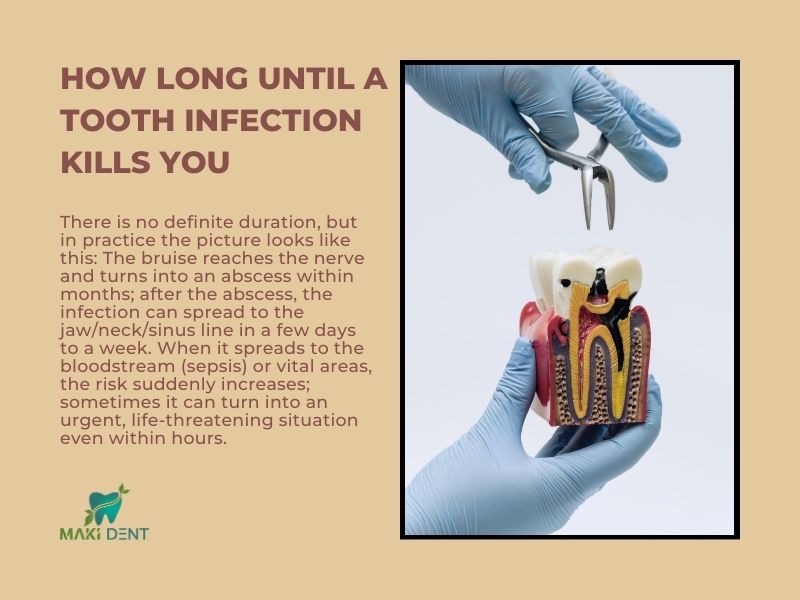
The infection starts when bacteria get as far as the pulp tissue inside the tooth; as the process grows, a pus-filled 'pocket' forms around the tooth, which we call a dental abscess. Although it sounds distant today, in the past this situation was much more dangerous: In London in the 1600s, dental infections were one of the leading causes of death. Even until the early 1900s, a considerable number of dental infections could result in death due to limited treatment options.
Let me be clear: Tooth infections often do not kill. With modern treatment, death is rare. But 'rare' does not mean 'impossible'. The biggest risk I see in my clinic is that people suppress the pain for a while and miss where the infection is heading.
The real answer to the question 'how many days?'
When asked 'Will I die immediately or will it take months?', it would be dishonest to say a single number. Because it is not the tooth that determines the duration; it is the route of infection, your immunity and the speed at which the infection spreads.
Nevertheless, if we talk in a timeline that patients can understand:
The classic scenario starting with caries: The decay usually progresses over months until it reaches the neurovascular tissue (pulp) inside the tooth. During this period, there is fluctuating pain such as 'it hurts, then it passes'. We see cold-hot sensitivity, intermittent throbbing, sometimes small swelling in the gums.
Trauma/crack scenario: A hard blow to the tooth, crack, fracture... Bacteria enter much faster. I hear some patients say, 'Something happened yesterday, today my face is swollen'. Yes, this is possible.
When an abscess forms: The pain is more 'sharp': throbbing, sleep-inducing, non-chewing pain. The gums become red, swollen and sometimes have a bad taste in the mouth. This is not the 'I can wait' stage; this is the stage when the body says 'I am fighting here'.
When does the fatal outcome begin?
Usually when the infection goes beyond the borders of the tooth and enters the jaw bones, neck tissues or bloodstream... That's when 'days' start to be spoken. Sometimes shorter.
The silent danger: The journey of infection through anatomy
The tooth looks like a small organ, but it is surrounded by critical neighbourhoods. The sinuses in the upper jaw, the floor of the mouth in the lower jaw and the soft tissues opening to the neck... When the infection finds the right cavity, it can spread downwards like gravity.
This spread has some names. I do not hide the medical term when explaining it to the patient, but I simplify it:
Sepsis (known as blood poisoning): When the infection enters the bloodstream, the body puts up a defence, sometimes outrageous. The pulse quickens, the temperature rises, the blood pressure may drop. This is what is described as 'I suddenly felt very bad'.
Ludwig's angina: Serious infection spreading from the lower jaw to the floor of the mouth. The most frightening part is this: the tongue and floor of the mouth start to swell, the airway may become narrowed.
Mediastinitis: Deep infections descending from the neck into the chest cavity. It is rare but severe. In such a case, the term 'dental abscess' is an understatement; it is now even in the field of thoracic surgery.
Brain abscess / vascular clots / endocarditis: It does not occur in every patient, but in some scenarios where the infection goes to the 'wrong place'. The issue here is not the tooth; it is the target of the infection in the body.
Let me emphasise this: Antibiotics sometimes relieve the pain but do not solve the problem. Because if there is pus accumulation (abscess) in or around the tooth, it is often like a 'closed room'. Antibiotic enters that room in a limited way. Without eliminating the source (drainage + root canal treatment or extraction), the infection continues to look for an opportunity.
At what point is 'waiting' no longer an option?
There are some complaints; the moment I hear them, my seriousness changes. Because it goes beyond the level of 'I'll go when I can find a dentist appointment'.
If you have any of the following, don't wait - urgent assessment is required
- Difficulty breathing or feeling of constriction in the throat
- Difficulty swallowing, increased salivation, inability to open the mouth (trismus)
- Rapidly increasing facial/jaw/neck swelling
- High fever, chills, marked weakness
- Unconsciousness, dizziness, feeling like fainting
- Significantly accelerated heart rate, 'feeling very unwell'
These symptoms may indicate that the infection has 'shifted'. At that point, waiting at home would be a matter of luck. As a dentist, I speak so clearly not to frighten the patient, but to protect life.
Who is at higher risk?
The same infection does not behave the same in two people. I have seen this a lot in my clinic:
- Diabetes (especially if uncontrolled)
- Those with a weak immune system
- Elderly patients
- Patients with malnutrition and chronic diseases
In this group, things that start as small may grow faster. In such patients, the sentence 'let me manage for one more week' means unnecessary risk.
How does the treatment proceed?
In a professional dental clinic, the treatment is often straightforward:
Drainage (emptying the abscess): If pus is present, it must be drained.
Root canal treatment: If it is possible to save the tooth, the source is cleaned and disinfected.
Extraction: If the tooth cannot be saved, it is necessary to remove the focus of infection.
Antibiotics: It supports in necessary cases, but it is usually not a solution on its own.
I tell the patient: 'You can save the day with painkillers, but infection does not negotiate with time.'
Personal message from a physician
The saddest moment for me is when the patient sees the swelling on his/her face and says: 'Actually, it has been there for three days, but I thought it would go away'. Because sometimes those three days change a lot medically.
Dental infection is a manageable problem most of the time. As long as we intervene at the right time.
Keep this sentence in mind:
Pain is the body's way of saying 'watch out'. Swelling and fever is the body saying 'hurry up'. Breathing and swallowing problems are the body's way of saying 'right now'.