
A dental crown protects and restores a damaged tooth, while a dental bridge replaces one or more missing teeth. Both are fixed dental restorations, but they serve different purposes. The right option depends on your teeth, oral health and treatment needs.
In this guide, we'll compare crowns and bridges, including their costs, lifespan and key differences. If you're considering dental treatment in Antalya, Turkey, our team at Makident can assess your teeth and help you understand which option may be suitable for you.
What is a dental crown?
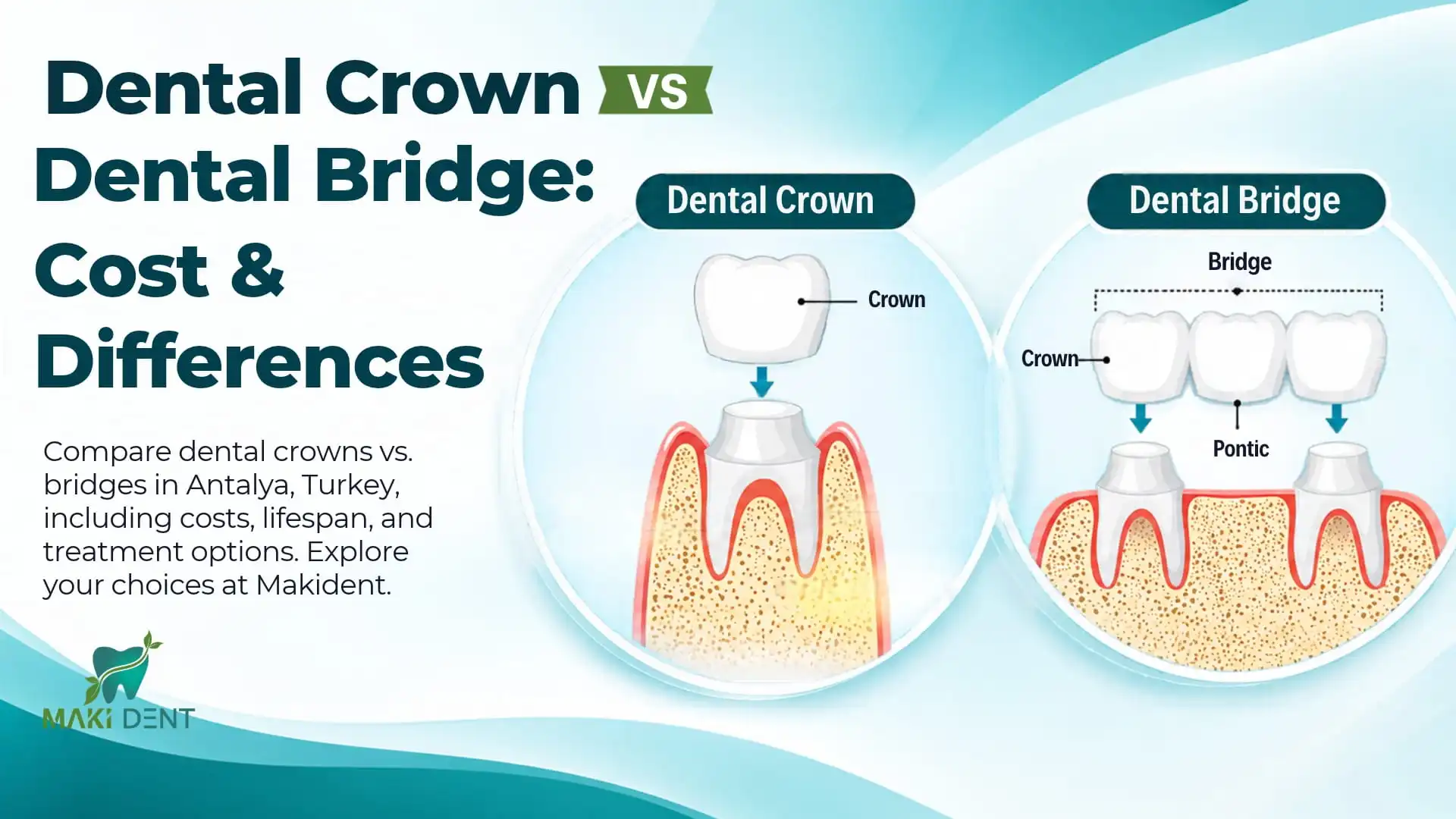
A dental crown is a cap that fits over your natural teeth. Crowns cover the part of your tooth above the gum. They protect your teeth from damage.
We usually use a crown when your tooth is badly broken, worn down or too weak to hold a regular filling.
We match the crown's shape, size and colour to your other teeth. So, you can have natural support similar to other teeth. Once it's fitted, you can use it to bite and chew much like your own tooth.

What is a dental bridge?
A dental bridge process is a fixed replacement for one or more missing teeth. We fill your gap with artificial teeth. So, how does it stay in place? We use the teeth on either side of the gap to support the bridge. Then, crowns are fitted over them, with the replacement tooth attached in between.
Unlike dentures, you do not need a dental bridge out at night. After treatment, you can smile, speak and chew as usual in the past.
Crown vs bridge: Key differences
| Feature | Dental crown | Dental bridge |
|---|---|---|
| Main purpose | Restores damaged teeth | Replaces missing teeth |
| Teeth involved | Usually, one tooth | Usually, multiple teeth |
| Tooth preparation | One tooth prepared | Supporting teeth prepared |
| Treatment time | Usually, two visits | Usually, two visits |
| Lifespan | 10–15+ years | 10–15+ years |
| Durability | Strong, individual restoration | Depends on supporting teeth |
| Cleaning | Regular brushing and flossing | Extra cleaning underneath |
| Cost | Lower overall cost | Higher overall cost |
| Tooth removal | No extraction required | No extraction usually required |
Treatment procedure and tooth preparation
The biggest difference is how many teeth we need to work on.
For a crown, we usually prepare just one tooth. We remove a thin layer from its surface, so the crown fits properly.
We need more preparation for a traditional bridge. If you're missing one tooth, we usually prepare the two teeth next to the gap. These teeth support the bridge, while an artificial tooth fills the space between them.
So, if your neighboring teeth are healthy, a bridge may mean removing some healthy tooth structure. That's something we always consider before recommending one.
Lifespan and durability
Both crowns and bridges can last 10–15 years or longer with good care. One scientific review found that around 89% of traditional dental bridges were still in place after 10 years. But a crown is generally easier to look after. Because crown covers just one tooth.
A bridge needs a little more attention. Food and plaque can collect underneath the replacement tooth, so you'll need to clean that area carefully.
There's also another difference. A crown depends mainly on the tooth underneath it. A bridge depends on its supporting teeth too. If one of those teeth develops a problem, the whole bridge may need attention.
Crown vs bridge cost in Antalya, Turkey
In Antalya, a zirconia crown typically costs around £120–£300. A traditional three-unit bridge costs roughly £360–£900, depending on the clinic and materials used.
A dental crown usually costs less than a bridge because you're paying for just one tooth.
Which one do you need: crown or bridge?
It mainly depends on whether your tooth is damaged or missing. If you still have your tooth, a crown may be enough to save it. If you've lost a tooth, a bridge could be a better option. Here's how to tell which one might be right for you.
When a crown is the right choice
If you still have your natural tooth, but it's damaged or weak, a crown may be the better choice.
We usually recommend a crown if:
- Your tooth is badly broken or cracked but can still be saved.
- You have a large filling and very little healthy tooth left.
- Your tooth is weak after root canal treatment.
- Your tooth is badly worn down.
- You have a dental implant that needs a permanent tooth on top.
The important thing is that your tooth must be healthy enough to support a crown. If the root is badly damaged or the tooth can't be saved, a crown won't solve the problem.
When a bridge is the right choice
If you've already lost a tooth, a bridge may be a good way to fill the gap.
We may recommend a bridge if:
- You're missing one or more teeth next to each other.
- The teeth on either side of the gap are strong enough to support a bridge.
- Those neighboring teeth already have large fillings or crowns.
- You don't want dental implant surgery.
- You want a fixed replacement that you don't have to remove.
FAQ
Yes, but you'll need a dental implant to support it. The implant replaces your missing tooth root, and we place a crown on top to give you a natural-looking tooth. A crown alone can't replace a missing tooth.
Yes, it can. In a traditional dental bridge, the teeth next to the gap are usually covered with crowns. These crowns hold the false tooth in the middle, so the whole bridge stays in place.
No, getting a crown or bridge is not painful. We use local anesthesia to numb your tooth and the surrounding area, so you won't feel pain during the treatment.
Yes, it can. With a traditional bridge, we need to remove some enamel from the supporting teeth to make room for the crowns. This can't be reversed. If you don't clean around the bridge properly, these teeth may also develop decay or gum problems. However, with good care, they can stay healthy for many years.

Dt. Merve Çelik
DENTIST · MAKIDENT DENTAL CLINIC · ANTALYA
Dt. Merve Çelik graduated from Istanbul Okan University and is a partner at Makident Dental Clinic in Antalya, Turkey. Her clinical work includes zirconia crowns, dental bridges, laminate veneers and other restorative dental treatments.
Medically reviewed by Dt. Merve Çelik
Published on
This article is for general information only and does not replace professional dental advice. Always consult a qualified dentist before treatment.
Sources
https://www.mouthhealthy.org/all-topics-a-z/crowns/
https://pubmed.ncbi.nlm.nih.gov/17594374/
https://www.uhnm.nhs.uk/media/jnumshbr/agenda-item-07e-reapproved-crowns-and-bridges.pdf