
Yes, a bad toothache can trigger a headache. The pain signals from your teeth and the pain signals from your head travel through the same relay station in the brainstem, called the trigeminal-cervical complex. When dental pain is strong or prolonged, it can overload that shared station, and the pain starts to spread beyond the tooth into the rest of the head.
Common Non-Dental Causes of Tooth Pain
Not every pain felt in a tooth actually starts in the tooth. Because the nerves of the face, jaw, sinuses and neck all report to the same processing centres, a problem in one of these areas can be felt as if it were coming from a tooth. This is called referred pain, and it's one of the reasons toothache can be so hard to diagnose without an examination.
Headache and Neurovascular Disorders
Some headache types involve the trigeminal nerve directly, which is why they can be mistaken for a dental problem:
- Migraine: In some patients, migraine pain settles almost entirely in the lower face or the teeth, upper or lower jaw, without the throbbing head pain people usually associate with migraine. This pattern is sometimes called "facial migraine," and it's easy to confuse with pulpitis because both can be described as a deep, throbbing ache.
- Cluster headaches: Among the most severe pain conditions in medicine, cluster attacks are one-sided and often centre around the eye or temple, but the pain can radiate down into the upper back teeth. What sets it apart from a dental abscess is the cluster of autonomic symptoms that accompany it — watering of the eye, nasal congestion on the same side, and sometimes a drooping eyelid.
- Tension-type headache (TTH): The most common headache overall. It's usually described as a tight band around the head, and the muscle tension driving it can refer pain into the jaw and teeth, especially the back teeth.
- Chronic paroxysmal hemicrania (CPH): A rare disorder that often starts as a throbbing or piercing pain in the upper jaw teeth, which makes it one of the more convincing toothache mimics. Its defining feature is that it responds completely to the drug indomethacin — a response so consistent it's used as a diagnostic test.
Issues with the Sinuses
The roots of the upper back teeth sit very close to the floor of the maxillary sinuses — in some patients, only a thin layer of bone separates them. When these sinuses become inflamed or infected (sinusitis), the buildup of pressure and fluid can produce a dull, aching or throbbing pain that feels like it's coming from the upper molars and premolars. A useful clue is that sinus-related tooth pain tends to affect several upper teeth at once rather than a single one, and it typically gets worse when bending the head forward, coughing or sneezing.
Muscle Pain and Temporomandibular Disorders (TMD)
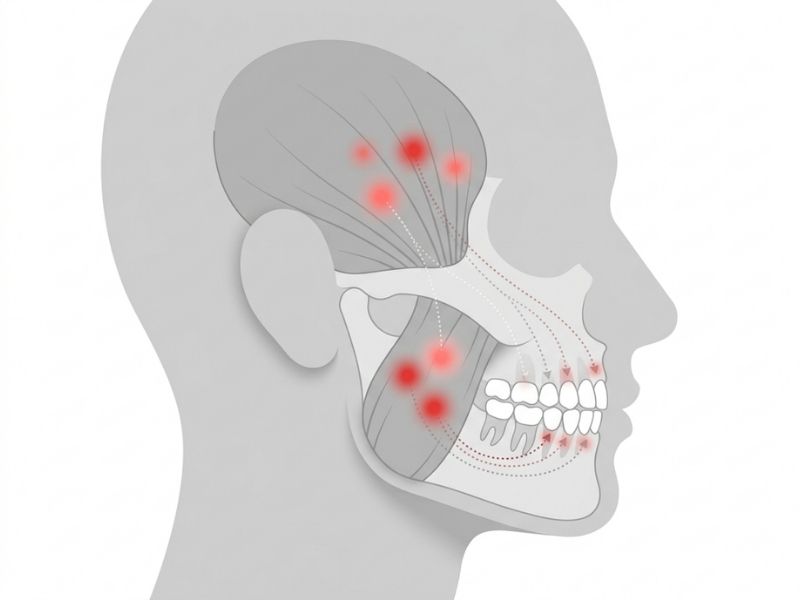
The jaw joint and its surrounding muscles are closely wired into dental sensation:
- Trigger points in the chewing muscles, particularly the masseter and temporalis, can refer pain directly to specific teeth. A trigger point in the temporalis, for example, often refers pain to the upper teeth, while trigger points in the masseter tend to refer to the lower back teeth.
- Teeth grinding or clenching (bruxism) puts repeated, often unconscious, stress on the ligaments holding each tooth in its socket. Over time this leads to tooth sensitivity and a dull ache that can be very hard to distinguish from decay, especially since bruxism also tightens the jaw and temple muscles and can trigger a genuine tension headache alongside it.
Disorders of the Nerves
- Trigeminal neuralgia: Sudden, severe, electric-shock-like pain on one side of the face, often triggered by something as mild as brushing the teeth, touching the face, or a cool breeze. Because the pain can land directly on the teeth, it's frequently mistaken for a dental emergency before the diagnosis becomes clear.
- Occipital neuralgia: Irritation of the nerves at the base of the skull, at the back of the head. Because these nerves have connections into the trigeminal system, the pain can be felt travelling forward into the face and teeth.
- Shingles (herpes zoster): When this viral infection affects a branch of the trigeminal nerve, it can cause a burning, toothache-like pain days before the characteristic rash and blisters appear, which is part of why early shingles is sometimes misdiagnosed as a dental problem.
Other Systemic and Serious Health Issues
- Heart attack and angina: Cardiac pain can radiate to the lower jaw and teeth, particularly in women and in diabetic patients, where classic chest pain may be absent. Jaw or tooth pain that appears with exertion and eases with rest is a red flag that should never be treated as a dental issue alone.
- Oral and throat cancer: A tumour in the mouth or throat can cause toothache-like symptoms either by pressing directly on a nerve or by irritating surrounding tissue. It's one of the reasons a non-healing sore or persistent one-sided pain deserves a proper look rather than being assumed to be dental.
- Diabetes: Poorly controlled blood sugar increases the risk of decay and gum disease, and the nerve damage (neuropathy) that can come with long-standing diabetes may also distort how pain is perceived in the mouth.
- Vitamin B12 deficiency: Has been linked to oral pain and burning sensations in the mouth and tongue, sometimes presenting as vague tooth discomfort with no visible cause.
- Substance use: Methamphetamine use ("meth mouth") causes severe tooth and jaw pain through a combination of dry mouth, heavy grinding, and rapid decay, all acting at once.
How Does a Toothache Actually Cause a Headache?
Triggering a Chronic Headache
Acute dental pain, or the trauma of dental treatment itself, is a significant stressor for the nervous system. In someone who already has a tendency toward migraine or tension headache, that stress can be enough to bring on an attack that had been dormant for months or years.
Central Sensitisation
An injury or procedure in the mouth sends a heavy volume of signals up through the trigeminal nerve to the pain-processing centres in the brainstem and brain. When that volume is high enough for long enough, the nervous system becomes "sensitised" — it starts registering ordinary, non-painful input as pain. This is why some patients notice their whole face or scalp becomes tender to light touch after a bad dental episode, well beyond the original tooth.
Pain Remapping
A related effect of central sensitisation is that the brain's pain map can shift. Migraine attacks that develop after dental trauma sometimes settle in exactly the area where the original tooth pain was felt, which makes the patient convinced the tooth is still the problem even after it has been treated and the dentist can find nothing wrong with it.
Neural Convergence and Spread
The nerve pathways from the teeth, the chewing muscles and the upper neck all converge on the same brainstem structure, the trigeminal-cervical complex. Because they share this common relay point, a strong, sustained pain signal from one tooth can effectively "leak" into the pathways serving the rest of the head, producing pain that feels widespread rather than confined to one spot.
Muscle Tension and Overlapping Conditions
TMJ disorders and dental problems are common alongside migraine and tension-type headache, not by coincidence. Toothache changes how a person chews, and the clenching that often accompanies dental pain (bruxism) keeps the jaw, temple and neck muscles under constant tension. That tension can trigger a muscle-based headache on its own, and once both are present they tend to feed each other.
Distinguishing a Tooth-Related Headache From a Primary Headache
Because these conditions can mimic each other so closely, telling them apart usually comes down to a handful of clinical clues rather than any single test.
Nature of the Pain and Its Triggers
Tooth-related pain is typically sensitive to hot, cold or sweet, and gets worse with pressure — biting down or tapping the tooth. Pulp inflammation usually produces a dull, constant ache or a throbbing pain that builds gradually. Headache-related pain behaves differently depending on the type: migraine can be throbbing and episodic in a way that overlaps with toothache, but trigeminal neuralgia is the opposite — sudden, lasting only seconds, and set off by harmless things like brushing or a light touch to the face.
Presence of Autonomic Symptoms
Ordinary toothache almost never comes with autonomic symptoms. When pain in the face is accompanied by any of the following, it points toward a neurovascular cause rather than a dental one — this group is known clinically as the trigeminal autonomic cephalalgias, and includes cluster headache:
- Watery, red eyes (conjunctival injection)
- Nasal congestion or a runny nose on the same side as the pain
- A drooping eyelid or facial sweating
Migration and Response to Treatment
Dental pain generally stays confined to one tooth or a small area. If the pain keeps moving from tooth to tooth, switches sides, or — importantly — doesn't resolve after appropriate dental treatment such as a filling, root canal or extraction, that's a strong signal the source isn't dental at all, and a medical rather than dental cause should be considered.
Posture and Response to Medication
Sinus-related pain has a fairly reliable postural pattern: it worsens when the head is tipped forward, when coughing, or when lying down. On the medication side, chronic paroxysmal hemicrania has a near-diagnostic feature — pain that mimics a toothache in the upper jaw but resolves completely with indomethacin. If a course of indomethacin eliminates the pain, that result alone confirms CPH rather than a dental cause.
What the Clinical Exam Adds
One of the most useful tools a dentist has for sorting this out is a local anaesthetic test: numbing the suspected tooth or area. If the pain disappears completely once the area is anaesthetised, the tooth is very likely the true source. If the pain continues despite the tooth being numb, the source is probably referred pain from somewhere else, or a primary headache disorder. The absence of any visible problem on a dental X-ray — no decay, no abscess, no cracked tooth — is another piece of evidence pointing away from a dental cause.
When to Get Medical Care

Knowing when to see a dentist versus when to seek urgent or specialist care matters here:
- Any kind of toothache: Sharp, brief pains, throbbing aches, or even a mild but persistent ache are all reasons to see a dentist rather than wait it out.
- A dull ache that lasts for days: Can indicate a spreading infection or an abscess forming, which won't resolve on its own.
- Treatment that didn't work: If pain continues after a root canal or extraction, or spreads to teeth that weren't treated, that calls for a specialist assessment rather than repeating the same treatment.
- Gum and jaw symptoms: Swollen or red gums, or pain around an erupting wisdom tooth, should be checked rather than managed with painkillers alone.
- Jaw pain with exertion: Jaw or tooth pain that comes on with physical activity and eases with rest can be a warning sign of a heart attack or angina and needs urgent medical attention, not a dental appointment.
- Giant cell arteritis: In anyone over 50, new temple pain, changes in vision, or jaw pain that worsens with chewing (jaw claudication) needs urgent care — untreated, this condition can cause permanent vision loss.
- Possible oral cancer: A mouth sore that hasn't healed within one to two weeks, unexplained numbness, unusual swelling, or persistent throat pain should be examined promptly rather than watched.
Treatment
Treatment depends entirely on where the pain is actually coming from — a dental source is treated very differently from a neurovascular or systemic one.
Treating the Dental Problem Directly
When the headache is genuinely driven by a dental issue, resolving that issue removes the headache along with it:
- Decay, cracks or broken restorations are repaired with fillings or crowns
- An infected or inflamed pulp is treated with a root canal; if the tooth can't be saved, extraction follows
- Teeth that can't be restored, or impacted wisdom teeth, are extracted
- Gum disease is managed with scaling and root planing to remove plaque and calculus below the gumline
Treating the Jaw Joint and Muscles
Where bruxism or muscle tension is the driver:
- A custom night guard (occlusal splint) reduces the strain grinding puts on the teeth and jaw muscles overnight
- Trigger point injections with local anaesthetic can settle pain originating in the masseter or temporalis and referring into the teeth or head
Medication and Differential Diagnosis
When the pain turns out not to be dental at all, treatment shifts to the medical side:
- A course of indomethacin serves as both diagnosis and treatment for chronic paroxysmal hemicrania — a full response confirms it isn't a tooth problem
- Trigeminal neuralgia is typically managed with anticonvulsant medication, and in some cases microsurgical treatment where medication isn't enough
- Where a neurological cause is suspected, referral for a proper neurological assessment is the right next step rather than further dental treatment
F.A.Q
Can a toothache cause a headache?
Yes, a bad toothache can give you a headache because of the shared nerve pathways in the trigeminal-cervical complex.
What does a toothache headache feel like?
Usually a dull, throbbing or pressure-type headache on the same side as the affected tooth. It can mimic a tension headache or migraine, and chewing typically makes it worse.
Can a cavity cause daily headaches?
Yes. Once decay reaches the nerve inside the tooth (pulpitis), the ongoing irritation can trigger a headache every day until the tooth is treated.