
'Buck teeth,' or 'rabbit teeth,' as they are commonly referred to in our language, are a dental condition that is frequently seen in society but equally misunderstood. This term is generally used to describe situations where the upper front teeth are significantly more prominent than the lower front teeth. In medical terminology, this condition is called 'overjet.'
In this article, we will cover everything from what buck teeth are, their causes, possible consequences, modern treatment methods, and psychological aspects.
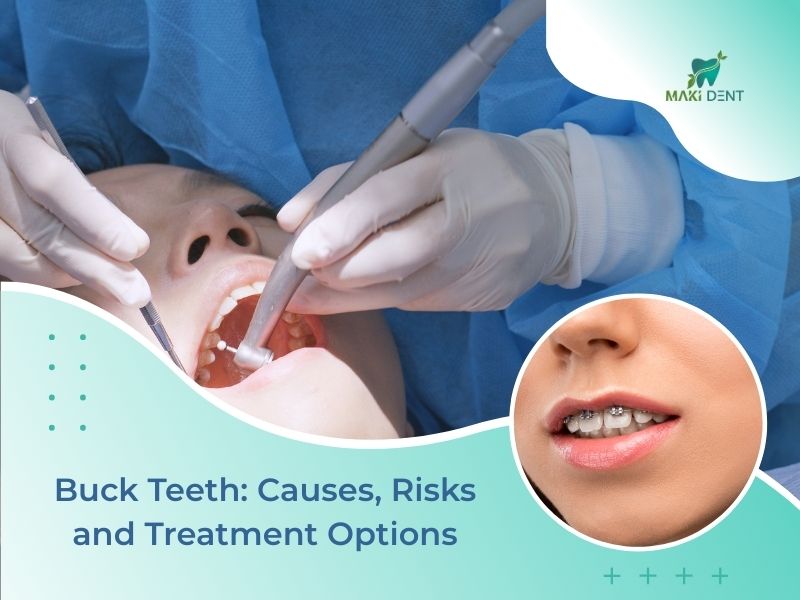
What exactly are buck teeth (overjet)?
Most people confuse 'buck teeth' with 'deep bite' (overbite). However, they are two different things.
Buck teeth (overjet):
This relates to the front-to-back relationship of the teeth. In other words, it shows how far the upper teeth protrude in front of the lower teeth. Imagine extending your finger straight out; that's the distance. Normally, it being 1-2 mm forward is not a problem; in fact, it's normal. But if this gap exceeds 3-4 mm, then the term 'buck teeth' comes into play.
Overbite:
This is entirely about the vertical relationship. It relates to how much the upper teeth cover the lower teeth when biting down. Normally, the upper teeth should cover the lower teeth by 20-25%. When this ratio is much higher, meaning the lower teeth are almost invisible, we call this an overbite.
How do buck teeth appear from the outside?
- The upper front teeth protrude noticeably outwards.
- Difficulty closing the lips, leaving the mouth slightly open at rest.
- Friction or contact between the front teeth and the lower lip.
- When viewed from the side, it may cause the chin to appear further back.
Factors causing buck teeth
Many factors play a role in the development of buck teeth, ranging from genetics to childhood habits. The most common causes are:
Genetics
This is the most dominant cause. If your family (parents, siblings) has a similar tooth structure, you are also likely to have it. This stems from hereditary characteristics such as the growth pattern of your jawbones, the size of your teeth, and the position of your tongue. For example, if you have a small lower jawbone with normal-sized upper teeth, this causes the upper teeth to protrude relatively more.
Childhood habits:
Thumb sucking:
A prolonged and intense thumb-sucking habit, especially during the period when permanent teeth begin to erupt (after the age of 6-7), applies a constant forward pushing force to the teeth. This causes the upper front teeth to be pushed forward and the lower front teeth to be pulled inward.
Prolonged use of pacifiers and bottles:
As with thumb sucking, these habits can negatively affect tooth and jaw development if they continue after the age of 3-4.
Tongue thrusting habit:
This is when the tongue is pushed behind or between the front teeth instead of its normal position on the palate, either during swallowing or at rest. With each swallow, the tongue presses against the teeth, gradually pushing them out of place.
Tooth-related problems:
Absence or retraction of lower teeth:
Congenital absence of lower incisors or their early extraction may cause the upper teeth to tilt forward due to lack of support.
Teeth grinding and clenching (bruxism):
This habit can cause wear on the teeth and changes in the jaw joint, leading to a misaligned bite.
Breathing problems:
Constant mouth breathing, for example due to chronic nasal congestion, adenoids, or allergies, causes the tongue to fall back against the floor of the mouth and the cheek muscles to press against the upper teeth. This imbalance of forces can contribute to narrowing and protrusion of the upper teeth and jaw.
Potential risks and consequences of buck teeth
Buck teeth are not merely an aesthetic concern. If left untreated, they can lead to a range of physical and psychological problems.
Physical risks:
Risk of trauma and fracture:
As the front teeth are located in the most vulnerable area of the face, they are the most susceptible to breaking or falling out in accidents such as falls or collisions. This risk is significantly higher in cases of buck teeth.
Speech impairments:
Difficulties may arise in correctly pronouncing sounds such as 'F', 'V', 'S', and 'Z' (labiodental and interdental sounds). This affects the intelligibility of speech.
Impaired chewing function:
The front teeth are designed to cut food. When these teeth do not close properly, chewing becomes inefficient, and this can place extra strain on the digestive system.
TME (temporomandibular joint) problems:
Incorrect closure can place excessive strain on the jaw joint, causing pain, clicking in the jaw, locking, and headaches.
Oral hygiene problems:
When the front teeth do not close properly, the upper and lower teeth cannot clean each other. This increases the risk of gum recession, gum inflammation, and tooth decay.
Sleep apnea:
In severe cases, a receding lower jaw can contribute to narrowing of the airway and an increased risk of sleep apnea.
Psychological and social effects:
Unfortunately, expressions such as 'rabbit teeth' in society can cause serious psychological trauma, especially during childhood and adolescence:
- Lack of self-confidence
- Social anxiety and introversion
- Avoiding smiling
- Poor performance at school or work
- Depression and anxiety
Buck teeth treatment methods
Buck teeth, like other dental and jaw problems, are a condition that modern dentistry and orthodontics can effectively resolve. The most appropriate treatment is determined based on age, the severity of the problem, and the underlying cause.
The important thing is to take action rather than simply accepting the situation. Whether you are concerned for yourself or your child, the first and most important step is to consult an experienced orthodontist and undergo a comprehensive examination. The treatment will not only straighten your teeth but also rebuild your self-confidence and give you a healthy, functional, and beautiful smile.
Buck teeth treatment methods include:
Childhood and adolescent treatments
This period is a golden opportunity because the jawbones are still growing and developing.
Habit-breaking appliances:
If there is a habit of thumb sucking or tongue thrusting, fixed or removable appliances are used to break this habit.
Orthodontic appliances (jaw expansion):
If the upper jaw is narrow, appliances such as a 'rapid palatal expander' are used to widen the jaw, creating space for the teeth and correcting some of the forward protrusion.
Functional orthodontic appliances:
These appliances encourage the lower jaw to grow forward, thereby reducing overjet. (e.g., Twin Block, Herbst appliance)
Early orthodontic treatment:
In cases where crowding is also present, early intervention with braces may be possible.
Adult orthodontic treatment
As jaw growth has ceased in adults, treatment focuses more on moving the teeth or on surgery.
Traditional braces (brackets):
Both upper and lower teeth are aligned using metal or transparent (ceramic) brackets to correct overjet. Elastics can also be used during treatment to improve the position of the jaws relative to each other.
Invisalign (clear aligners):
This is an extremely effective option for mild to moderate buck teeth cases. These nearly invisible clear aligners gradually move the teeth using a series of 'attachments' (small bumps that stick to the teeth). It is one of the most popular options among adults due to aesthetic concerns.
Tooth extraction and treatment:
If there is severe crowding, one small molar is usually extracted from the upper jaw to create space for the front teeth to be moved back.
Orthognathic surgery (jaw surgery):
In very severe cases caused by skeletal factors, i.e., jawbone misalignment, surgery is the only permanent solution. In this procedure, the orthodontist and jaw surgeon work together. First, the teeth are straightened with braces, then the upper jaw is moved back, the lower jaw is moved forward, or both are moved into the correct position through surgery. This provides a significant improvement in quality of life.
Post-treatment, retention (retainer) and permanence
After treatment is complete, the most critical phase begins: retention. Your teeth are not yet accustomed to their new positions and tend to revert to their old positions (relapse). Therefore, it is vital to regularly use a retention appliance (retainer) as recommended by your dentist. These appliances can be fixed (thin wire bonded to the back of the teeth) or removable (clear aligners worn at night). If you do not take care during this stage, the entire treatment process may be wasted.
Recommendations for parents regarding buck teeth
Early observation: Monitor your child's teeth and jaw development from an early age.
Guide habits: Try to discourage habits such as thumb sucking and prolonged pacifier use as early as possible (before the age of 3-4).
First orthodontic examination: The American Association of Orthodontists recommends that the first orthodontic examination be performed no later than age 7. At this age, permanent teeth begin to erupt, and potential problems can be diagnosed early. Early diagnosis can make treatment much easier, shorter, and more economical.
Be supportive: If your child is being bullied by peers because of buck teeth, talk to them openly and show them that consulting an orthodontist is a solution.
F.A.Q.:
Do buck teeth cause wear or chipping of the teeth?
Yes, it is a significant risk factor. Because the upper and lower front teeth are not in their normal occlusal position:
Traumatic contact: The lower front teeth can rub against the back surface of the upper front teeth, causing them to wear down or chip.
Abnormal occlusal pressure: Abnormal forces are exerted on the teeth during chewing and swallowing.
Soft tissue injury: The lower teeth can irritate or injure the upper gums and palate.
How long does buck teeth treatment take?
It depends on the complexity of the case. Simple cases may take 1-1.5 years, while more complex cases may take 2 years or longer. Adult treatments generally take longer.
Is jaw surgery (orthognathic surgery) always necessary?
No, it is only necessary in severe cases caused by skeletal issues. If the problem is solely with the teeth or if early intervention was performed during childhood, treatment with braces is usually sufficient. Surgery is considered when there is a significant misalignment between the upper and lower jaws, typically after growth has been completed (usually after the age of 18).
Is tooth extraction necessary when correcting buck teeth?
Not always. This decision depends on the size of the teeth, the adequacy of the jawbone (space limitations), and the severity of the protrusion. In modern orthodontics, treatment without extraction is preferred whenever possible. Techniques such as jaw expansion or utilizing the spaces behind the teeth can avoid extraction. However, in cases of severe crowding and narrowness, extraction of one or two small molars may be necessary for the stability of the treatment and a healthy outcome. Your orthodontist will determine the most suitable method for you.
Will my facial appearance change during or after treatment?
Yes, there is usually a positive change. Buck teeth treatment not only straightens the teeth but also changes the support of the lips and surrounding soft tissues. The upper lip is freed from its overly stretched appearance and moves into a more natural position. When viewed from the side, the jawline appears more harmonious. However, this change varies depending on the individual's growth potential, age, and initial skeletal structure.
Can I play sports during treatment?
Yes, you can. However, if you play contact sports (basketball, football, boxing, etc.), it is strongly recommended that you use a custom-made mouthguard to prevent the brackets from damaging your cheeks and to protect your teeth from possible impacts.
Is treatment longer for adults than for children?
Generally, yes, it tends to be longer. The main reason for this is that bone metabolism and cellular renewal are slower in adults. Teeth move more slowly within the bone. Additionally, factors such as gum health, bone density, and previous fillings/crowns in adults can also affect the treatment plan and duration. On average, adult treatment can take 25-50% longer than a similar case in a child.
Will my facial appearance change during or after treatment?
Yes, there is usually a positive change. Buck teeth treatment not only straightens the teeth but also alters the support of the lips and surrounding soft tissues. The upper lip moves from an overly stretched appearance to a more natural position. When viewed from the profile, the jawline appears more harmonious. However, this change varies depending on the individual's growth potential, age, and initial skeletal structure.
Will the teeth shift again after treatment?
If the retention phase is neglected, yes, they may shift. Therefore, it is crucial to use retention appliances (wires or clear aligners) for the duration recommended by the dentist after treatment is completed.