
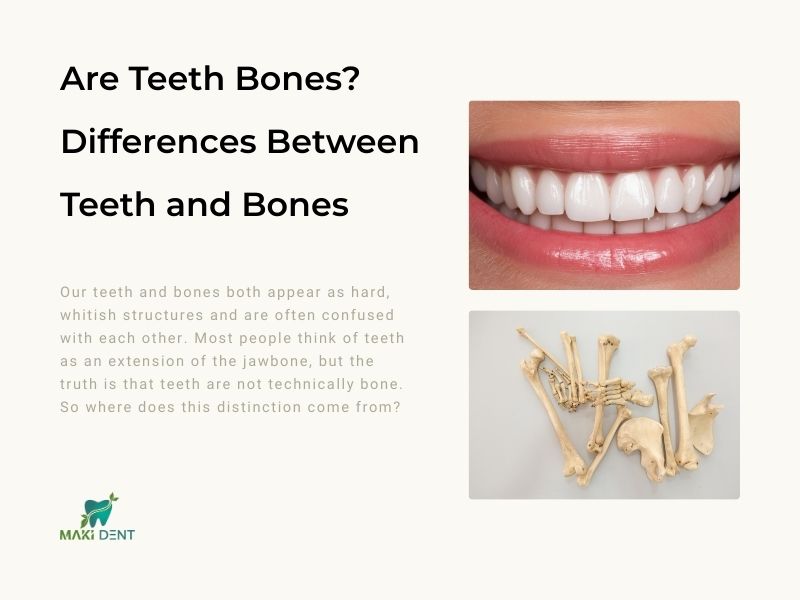
Our teeth and bones both appear as hard, whitish structures and are often confused with each other. Most people think of teeth as an extension of the jawbone, but the truth is that teeth are not technically bone. So where does this distinction come from?
What are bones made of?
Our bones are similar to reinforced concrete structures. Minerals (calcium/phosphorus) provide strength like the steel in the structure, while collagen (proteins) determines the structural tensile strength. This entire structure is equipped with living cells that can constantly renew themselves.
Basic structural materials (Hard parts)
Bones share many elements with teeth; these are mainly minerals such as calcium and phosphorus, which provide their hardness. A bone has two main layers:
Hard outer layer (Cortical bone):
This is the dense and compact part covering the outside of the bone. It is necessary to provide strength and support against pressures such as chewing and biting. Long bones have this dense compact bone layer.
Porous internal structure (Spongy or cancellous bone):
This is the structure found inside the bone, which is porous like a sponge. This porous structure contains bone marrow and blood vessels. Spongy bone provides flexibility and adaptability to the bone by distributing forces and absorbing shock. Flat bones consist of two thin layers of compact bone surrounding the spongy bone.
Living and repairing cells
Bones are living tissues that can repair themselves even when broken. This is a fundamental difference from teeth, which cannot repair themselves. The ability of bones to repair themselves is due to the special cells they contain:
Osteoblasts and osteocytes:
These cells form new bone tissue and renew bone tissue by regulating bone structure. When a broken bone is properly set, these cells enable it to heal itself and function almost as well as before.
What are teeth made of?
Teeth are hard, mineral-rich structures used for chewing food, but unlike the rest of the skeleton, they are not made of bone. Nevertheless, teeth and bones share many similar elements, such as calcium and phosphorus.
Teeth consist of four main tissues; three of these are hard, and one is soft. These hard tissues make up the bulk of the tooth.The basic structural components of teeth:
Hard tissues (Structural parts of the tooth)
Enamel:
The enamel covering the crown part of the tooth that you see from the outside is the hardest substance in the human body. The enamel layer protects the tooth from wear and tear and is almost entirely inorganic, as approximately 96% of it is mineralized.
Dentin:
Located immediately beneath the enamel, it forms the main body (bulk) of the tooth. Dentin is a living tissue. Approximately 70% of dentin is inorganic (mineral) and 30% is organic. Dentin contains microscopic tubules that connect to the pulp, the inner core of the tooth.
Cementum:
A thin, bone-like layer covering the root of the tooth and attaching the root surface to the jawbone. Cementum is approximately 50% mineralized.
Soft tissue (Centre of the tooth)
Pulp:
This is the soft tissue located in the core of the tooth. The pulp consists of blood vessels, nerves, and connective tissue that nourish the tooth and transmit sensory information. The pulp is located within narrow channels known as root canals, which extend from the crown to the root tip.
Do they have the ability to repair themselves?
Teeth, like bones, do not contain regenerating cells, so they cannot repair themselves when damaged (such as with cracks or fractures). While bones contain osteoblast and osteocyte cells that produce new tissue, the specialized cells that form teeth (ameloblasts form enamel and odontoblasts form dentine) do not possess this regenerative ability. Therefore, when a tooth is damaged, dental professional assistance is always required for repair.
What are the similarities and differences between teeth and bones?
Although teeth and bones are the hardest structures in our body, there are both important similarities and differences between them. These differences are particularly evident in terms of self-repair and structural components.
Similarities (Common features)
Main structural materials:
Both teeth and bones share many similar mineral elements, such as calcium and phosphorus, which give them their hardness. Bones and teeth are mineralized tissues that are chemically similar to each other.
Cementum, a thin, bone-like layer covering the root surface of teeth and attaching them to the jawbone, and dentine, which forms the main mass of the tooth, are chemically similar to bone.
Developmental mechanisms (Genetic similarity):
Growth factors and transcription factors involved in tooth development (odontogenesis) include molecules that also play a critical role in bone development. Bone Morphogenetic Proteins (BMPs) are one example of a key molecule that is very important for the growth of teeth.
How it reacts and wears:
Dentin and cementum are chemically similar to bone, so they can dissolve minerals when the environment changes, like when the pH is low. This means that both bone and dental tissues are likely to break down when archaeologists look at them.
Differences (Main points of difference):
Teeth are not made of bone, like the rest of the skeleton. The main differences are in the cells they have and how well they can fix themselves:
|
Feature |
Bones (Living Bone) |
Teeth (Hard Tissues) |
|
Fixing |
Yourself Can fix. Bones have cells that can heal themselves when they break or get hurt. |
Can't fix. They can't fix themselves, even small problems like cracks or chips, so they need dental work. |
|
Contained Cells |
Cells that are contained Include osteoblasts and osteocytes, which are cells that make new bone tissue and control how bone is built. |
Don't have any of these cells that can grow back. |
|
Structural Components (Outer Layer) |
The outer layer is cortical bone (dense and compact). |
The outer layer is enamel (the hardest substance in the body, 96% mineralized). Enamel is almost entirely inorganic. |
|
Mineralization Rate |
Bone: Less mineralized than dentin and cementum (Dentin is ~70%, Cementum is ~50% mineralized). |
Enamel: The hardest substance in the body, approximately 96% mineralized. |
|
Internal Structure (Vitality) |
The interior is porous cancellous bone (spongy bone) containing bone marrow and blood vessels; it is in a state of constant renewal. |
The bulk of the tooth is dentin; the interior contains the soft pulp, which houses blood vessels, nerves, and connective tissues. |
|
Response to Damage/Protection |
Bones respond to micro-cracks through repair. |
The tooth's enamel layer provides protection against wear, but damage is irreversible. |
Why teeth and bones are often confused?
Particularly before the invention of the compound microscope, the histological structure of teeth was unknown, so hard dental tissues such as dentine and cementum were sometimes confused with bone. Even ancient writers classified teeth as bone but noticed that they were harder.
Teeth and bones are often confused due to their hardness and basic mineral content, but differences in their cellular composition and self-repair mechanisms (regeneration) indicate that they are separate structures.
F.A.Q:
What is the hardest part of a tooth, and how much mineral does it contain?
Enamel, which covers the crown of the tooth, is the hardest substance in the human body. Enamel is approximately 96% mineralized.
Do teeth and bones share common genetic signals at the developmental level?
Yes. The fundamental molecules that govern bone and tooth development (e.g., Bone Morphogenetic Proteins—BMPs) form the fundamental pathways used during tooth development (odontogenesis).
What structure attaches and supports the teeth to the jawbone?
Teeth are held in place by the structural support provided by the alveolar bone within the jawbone (maxilla and mandible). The primary role of the alveolar bone is to provide a stable foundation for the teeth.
Why are teeth generally preferred over bones in archaeological research?
Teeth tend to preserve biomolecules (such as DNA and collagen) better than bones. This is because the decay-resistant enamel layer and their position within the jaw are thought to protect the dentine from microbial attacks and external infiltrating substances.
What is the importance of the jawbone in preserving teeth?
Conditions such as gum disease (periodontal disease) can lead to alveolar bone loss, and when the bones supporting the teeth are damaged, even perfectly healthy teeth can be lost.
Are microcracks (microfissures), which are common in bone tissue, also common in teeth?
No. Dentin and cementum are rarely affected by microcracks, whereas this condition is more common in bone and the enamel layer.
How does the enamel layer of the tooth protect the overall structure of the tooth and the dentine from excessive environmental conditions?
Enamel has high resistance to chemical dissolution; this ensures that the dentine area beneath the enamel remains well protected even in excessively abrasive environments where there is severe damage (generalized destruction) in the root region.